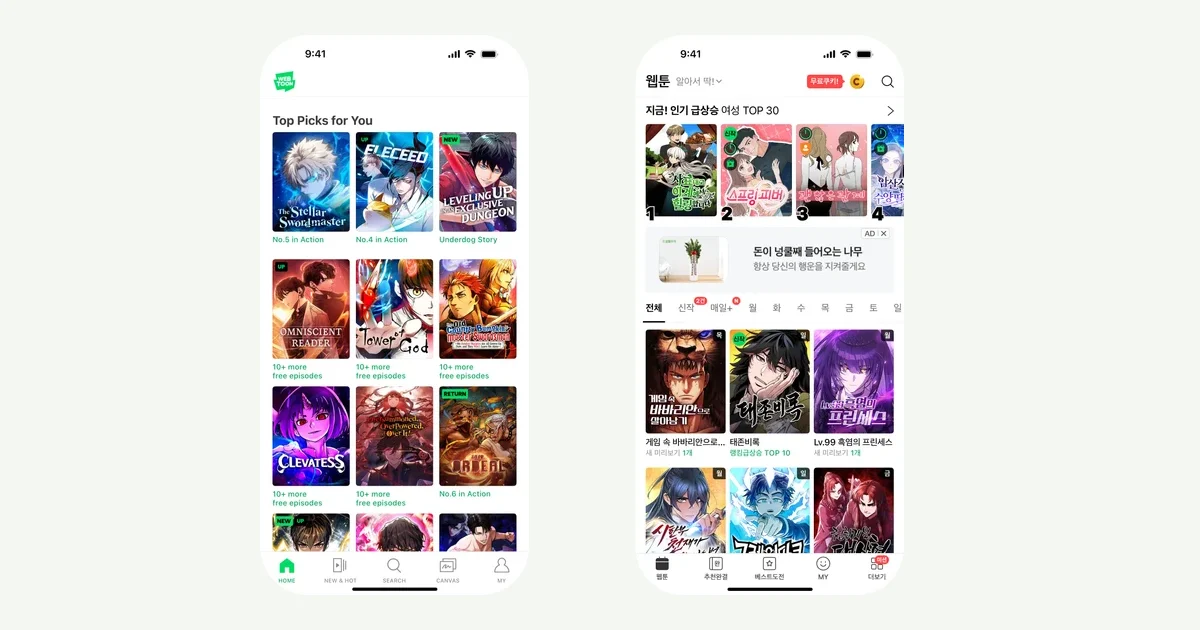
Korean Webtoons: What They Are, What's Popular Now, and How to Read
A Korean webtoon (웹툰) is a full-colour comic drawn as one long vertical strip, released episode by episode on a phone app. There are no pages to turn. You scroll down. Korea invented the format in the early 2000s, and it is now a ₩2.29 trillion industry at home (2024, Korea's official industry survey). Naver's webtoon company alone has about 157 million monthly readers worldwide.
This guide covers what makes a webtoon different from manhwa and manga, the numbers Korean sources publish, which titles Koreans are reading this week, what an episode actually costs in won, and which webtoons became 2026's K-dramas.
Solo Leveling Vol. 1: the most famous Korean webtoon, as a printed bookAffiliate link. As an Amazon Associate, EpicKor earns from qualifying purchases at no extra cost to you.
Quick Guide: Korean Webtoons in October 2026
| Question | Short answer |
|---|---|
| What is it? | A Korean digital comic made as one vertical scroll per episode, usually in full colour |
| Korean word | 웹툰 (wep-toon), from "web" + "cartoon". Korean comics in general are 만화 (manhwa) |
| Where Koreans read | NAVER WEBTOON (네이버웹툰) and KakaoPage / Kakao Webtoon (카카오페이지 / 카카오웹툰) |
| Where to read in English | WEBTOON (Naver's global app), Tapas (Kakao), Manta (RIDI). See our Naver vs Kakao app guide |
| Is it free? | Weekly episodes are free. You pay only to read ahead or catch up faster |
| Price to read ahead | Naver cookies (쿠키): 10 for ₩1,200 in the iPhone app. English WEBTOON: 10 coins for $0.99 |
| Size of the industry | ₩2.2856 trillion in 2024, up 4.4% (KOCCA, published 29 Dec 2025) |
| Biggest export market | Japan, with 49.5% of exports, then North America at 21.0% |
Webtoon vs Manhwa vs Manga: The Real Difference
These three words get mixed up all the time. Here is what each one means.
| Manhwa (만화) | Manga (漫画) | Webtoon (웹툰) | |
|---|---|---|---|
| What the word tells you | The comic is Korean | The comic is Japanese | A format, not a country |
| Reading direction | Left to right | Right to left | Top to bottom, one continuous scroll |
| Colour | Print: mostly black and white. Today: mostly colour | Usually black and white | Almost always full colour |
| Unit | Pages in a book or magazine | Pages in a weekly magazine, then a volume | No pages: one tall strip per episode |
| Release rhythm | Volumes | Weekly or monthly chapters, then volumes | Weekly episodes on a set weekday |
| How you pay | Buy the book | Buy the magazine or volume | Free weekly; pay per episode to read ahead |
In one line: manhwa says where a comic is from, and webtoon says how it is built. People confuse the two because almost every new Korean comic is now published as a webtoon. So in daily use, "manhwa" and "webtoon" usually mean the same thing.
That also answers the reading-direction question. Manga reads right to left because Japanese books do. A webtoon has no left or right at all. There is no page to turn, so the only direction is down.
The vertical format also changes how stories are told. A long empty gap between panels works as a pause. A reveal can sit just below the edge of the screen. A fight can fall down the strip like a moving camera. Your thumb controls the pacing. That is why a webtoon printed as a book feels different. The printed editions split the scroll into pages, which is worth seeing once if you love a series.
Tower of God, Vol. 1 (WEBTOON Unscrolled): the Naver classic by SIU, cut into pages. It is one of Naver Webtoon's longest-running hits, and it sits in the English app's Top Picks in WEBTOON's own media kit. The printed edition shows exactly what changes when a scroll becomes a book. As an Amazon Associate, EpicKor earns from qualifying purchases at no extra cost to you.
See Tower of God Vol. 1 on AmazonHow Korea Built the Webtoon
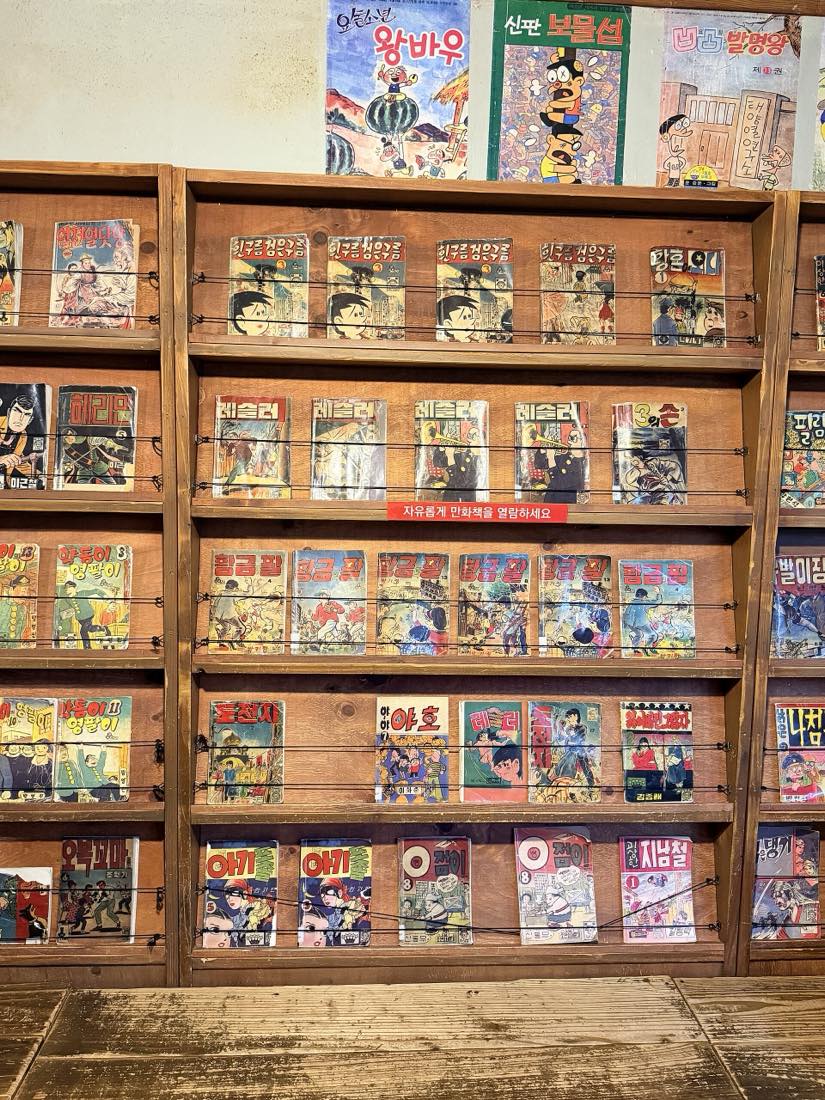
Korea had printed manhwa for decades, sold in magazines and lent out by neighbourhood comic-book shops (만화방). The internet changed how comics reached readers.
In the early 2000s, Korea's two big web portals started publishing comics on their own sites. Daum launched its comics section in 2003 and Naver launched Naver Webtoon in 2004. Both showed each episode as one long vertical image, not scanned pages, because that is how a web page scrolls. When smartphones arrived around 2010, the format already fit the screen.
Then came the business model that made webtoons a habit:
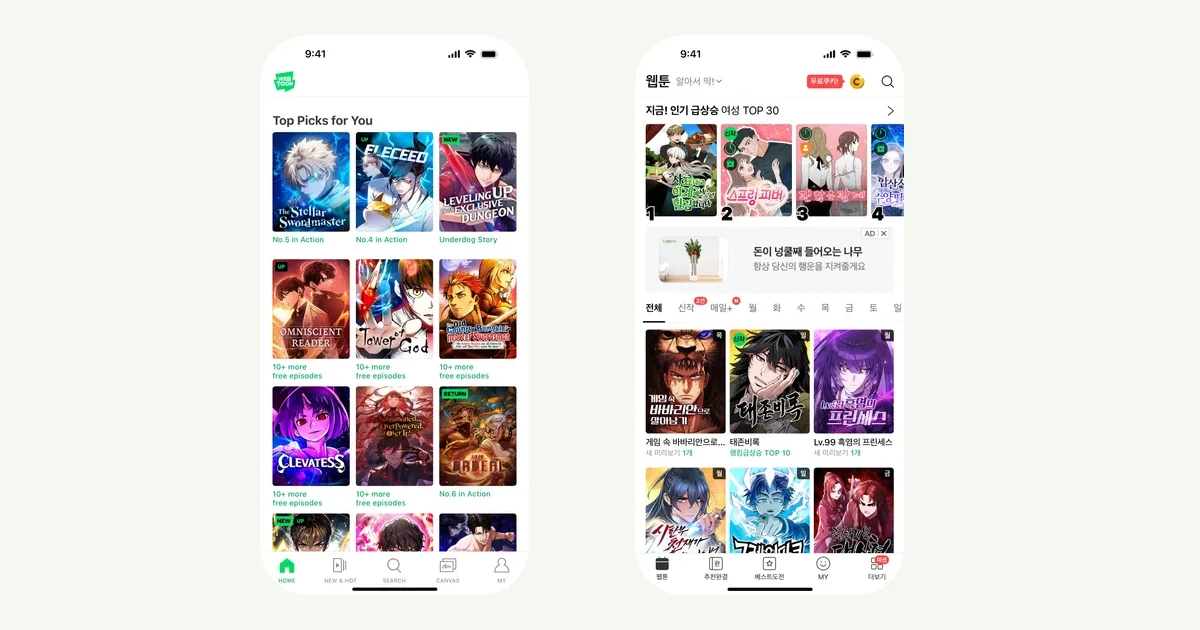
- Fixed weekdays. Every series updates on a set day, so readers check the Monday list on Monday. The Korean Naver app is organised by weekday tabs (월 화 수 목 금 토 일).
- Free to read, paid to read ahead. The newest few episodes are already finished. Readers pay a small amount per episode to see them early. Everyone else waits and reads them free.
- Wait-for-free. Kakao's 기다리면 무료 unlocks one paid episode for free every set number of hours. That turned binge-reading old series into a daily routine.
- Comments under every episode. Readers react together, and platforms can see which stories keep people coming back.
That last point is why TV studios love webtoons. A webtoon with a large audience has already proven its characters and plot before anyone films a scene.
Platforms work like infrastructure in Korea; our guide to Naver Map and Kakao T shows how a few home-grown apps run daily life. Webtoons followed the same path. The app is where readers follow their series week after week.
The Numbers: How Big Korean Webtoons Are in 2026
Most English articles still use old figures. These are the latest published numbers, mostly from Korean sources.
| Figure | Number | Source and date |
|---|---|---|
| Korean webtoon industry revenue, 2024 | ₩2.2856 trillion (+4.4%) | KOCCA / Ministry of Culture, 2025 웹툰산업 실태조사, 29 Dec 2025 |
| Same figure, 2023 | ₩2.189 trillion | KOCCA, 2024 survey |
| Export share by region | Japan 49.5% · North America 21.0% · Greater China 13.0% · Southeast Asia 9.5% · Europe 6.2% | KOCCA, 29 Dec 2025 |
| Pirated webtoon market, 2023 | ₩446.5 billion (about 20% of the legal market) | KOCCA, 2024 survey |
| WEBTOON Entertainment monthly active users | 156.9 million (Q2 2026) | Company results, 10 Aug 2026 |
| Monthly paying users, all markets | 7.5 million | Same |
| Paying users in Korea alone | 3.8 million (+10.4% year on year) | Same |
| WEBTOON revenue from Korea, Q2 2026 | about US$93.5 million (+16%) | Same |
What the numbers show:
- Growth has slowed. The industry grew 19.7% in 2023 but only 4.4% in 2024. KOCCA notes that 2024 is the first year measured as a national statistic, so the two years are not perfectly comparable. Korea's own market is maturing, and new money now comes from exports, merchandise and TV adaptations.
- Japan buys half of the exports. Webtoons are now a big part of how Japanese readers read comics on their phones.
- Korea pays. Almost half of WEBTOON's paying users worldwide (3.8 of 7.5 million) are in Korea, a country of about 51 million people. Korean readers are used to paying ₩200–300 to read the next episode early.
- Piracy is the biggest leak. The 2025 survey asked webtoon companies what the industry needs most. Tougher action against piracy sites came second, at 35.4%, behind investment support at 42.2%. When you read on an official app, the creator gets paid.
The 2025 survey is also the first to count as an official government-approved national statistic (국가승인통계 No. 467002). That makes it the most reliable size figure available.
What Koreans Are Reading This Week
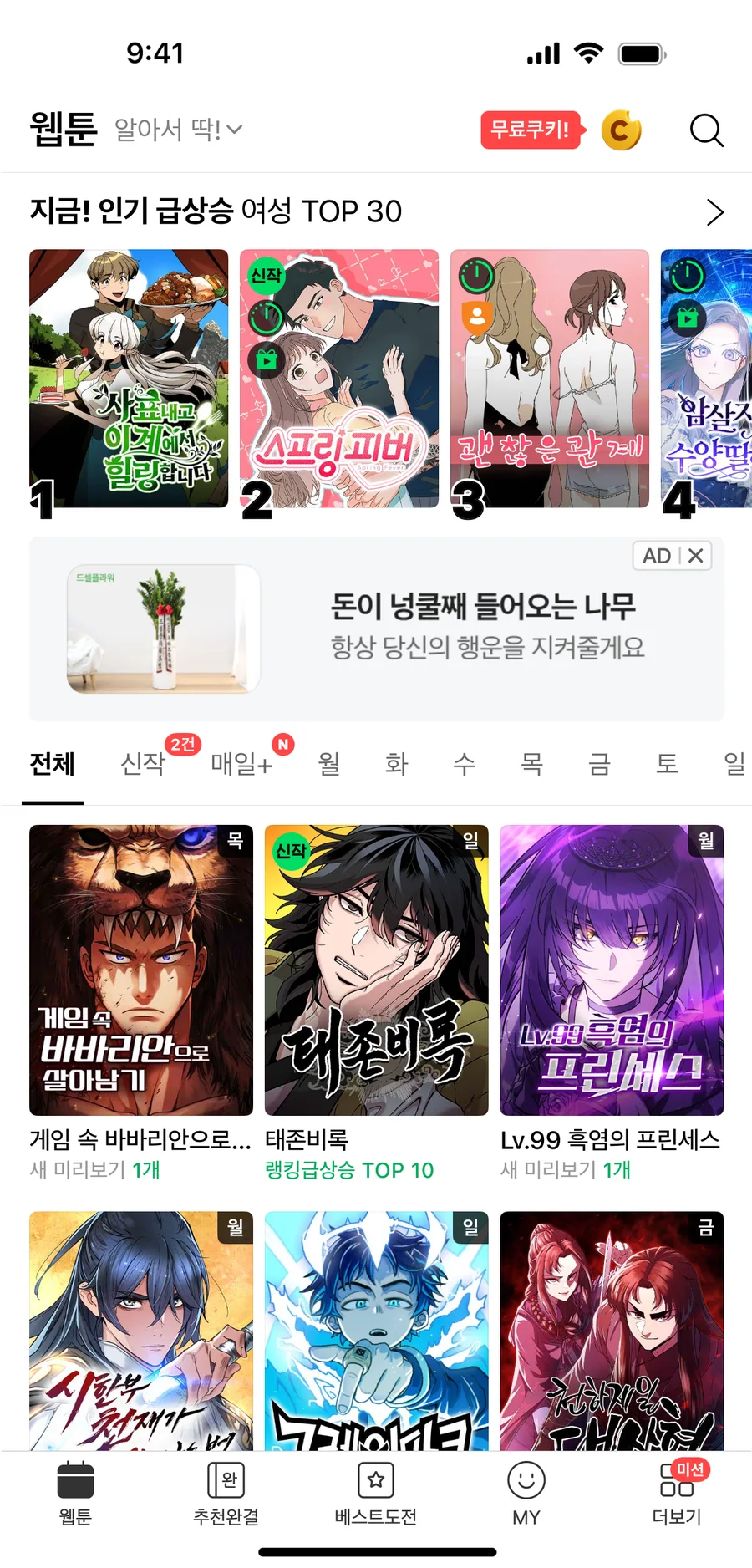
The quickest way to see what Korea is reading is the Korean Naver app's weekday chart. Here is the No. 1 title on each weekday, sorted by popularity (인기순), as of 8 October 2026:
| Day | No. 1 on NAVER WEBTOON | What the title means / English title | Genre |
|---|---|---|---|
| Monday (월) | 신체 (Sinche) | "Body" | Body-horror thriller, drawn in black and white (19+) |
| Tuesday (화) | 괴력 난신 (Goeryeok Nansin) | "Strange Powers, Chaotic Spirits" | Martial arts (murim), action |
| Wednesday (수) | 화산귀환 (Hwasan Gwihwan) | On WEBTOON: Return of the Blossoming Blade | Martial arts (murim) |
| Thursday (목) | 나의 경험 (Naui Gyeongheom) | "My Experience" | Romance (19+) |
| Friday (금) | 광마회귀 (Gwangma Hoegwi) | On WEBTOON: Return of the Mad Demon | Martial arts, regression (회귀) |
| Saturday (토) | 호랑이형님 (Horangi Hyeongnim) | "Big Brother Tiger" | East Asian folk fantasy |
| Sunday (일) | 육아일기 (Yuga Ilgi) | "Parenting Diary", by the cartoonist 자까 | Everyday-life comedy |
Older hits are also still in the top three: 외모지상주의 (Lookism) on Fridays and 참교육 (Get Schooled) on Mondays. Both have been running for years and both are known in English.
Notice how much martial arts (무협 / murim), romance and "second chance" stories (회귀, a hero going back in time) dominate. Wednesday's 화산귀환 is in its third season. WEBTOON Entertainment's August 2026 results named it as one reason Korean revenue grew. If you want what Korea is reading right now rather than what is famous in English, start with murim.
How to Read Korean Webtoons in English, and What It Costs
You can read most of the famous titles legally and mostly free. The apps differ in what they charge and what they call the currency:
| App | Who runs it | Currency | Price (as of October 2026) | Free option |
|---|---|---|---|---|
| NAVER WEBTOON (네이버웹툰), Korean | Naver | Cookies (쿠키) | iPhone app: 10 cookies ₩1,200 (₩120 each). Web purchase: ₩100 each | Weekly episodes free; read-ahead episodes (미리보기) cost cookies |
| KakaoPage (카카오페이지), Korean | Kakao Entertainment | Cash (캐시) | iPhone app top-ups from ₩1,200 to ₩14,000 | 기다리면 무료: one episode unlocks free after a timer |
| WEBTOON, English | Naver (Nasdaq: WBTN) | Coins | 10 coins $0.99; former Daily Pass episodes cost 3 coins each | Weekly episodes free; some episodes unlock by watching an ad |
| Tapas, English | Kakao | Ink | Varies by series | Wait-until-free on many series |
| Manta, English | RIDI | Subscription | One monthly fee, no per-episode charges | Some free episodes per series |
Three practical points:
- The phone app costs more than the website. On 23 May 2022 Naver raised the Android app's cookie price from ₩100 to ₩120, after Google raised its in-app billing fee, but kept ₩100 for web purchases. The iPhone app also charges ₩120. If you are in Korea with a Naver account, buy cookies on the website.
- WEBTOON ended Daily Pass on 29 May 2025. Many English guides still tell you to "wait for the Daily Pass." It is gone. Those episodes now cost coins, or you unlock some by watching ads.
- The Korean app is ahead of the English one. Popular series often run several episodes ahead in Korean. The Korean app is in Korean only, and buying cookies needs a Naver account.
For a full comparison of the apps, see our guide to where to read Korean webtoons. It explains why WEBTOON and Naver Webtoon are the same company and where Kakao's catalogue appears in English.
Webtoons That Became K-Dramas
A large share of Korean hit series started as webtoons. Here are the best-known adaptations, including the 2026 releases:
| Drama | Original webtoon | Where it first ran | Released |
|---|---|---|---|
| The Legend of Kitchen Soldier | 취사병 전설이 되다 | tvN / TVING | 11 May 2026 |
| Teach You a Lesson | 참교육 (Get Schooled), Naver | Netflix, 10 episodes | 5 June 2026 |
| Agent Kim Reactivated | 김부장, Naver | SBS, then Netflix | 26 June 2026 |
| Chicken Nugget | 닭강정, Naver | Netflix | 2024 |
| Moving | 무빙 by Kang Full, Daum (now Kakao) | Disney+ | 2023 |
| All of Us Are Dead | 지금 우리 학교는, Naver | Netflix | 2022 |
| Business Proposal | 사내 맞선, KakaoPage | SBS / Netflix | 2022 |
| Sweet Home | 스위트홈, Naver | Netflix | 2020 |
| True Beauty | 여신강림, Naver | tvN | 2020 |
| Itaewon Class | 이태원 클라쓰, Daum (now Kakao) | JTBC / Netflix | 2020 |
The three 2026 shows all became big hits. Agent Kim Reactivated (김부장) passed 20% nationwide ratings on SBS by its fourth episode. It was also No. 1 in Netflix's global non-English TV chart for three weeks in a row. Teach You a Lesson topped Netflix's weekly non-English TV chart for four weeks. The Legend of Kitchen Soldier is the show WEBTOON Entertainment named when it reported 16% revenue growth in Korea. Webtoon-based dramas now bring readers back to the webtoon apps.
True Beauty, Vol. 1 (WEBTOON Unscrolled): the Naver hit behind the 2020 tvN drama. Yaongyi's 여신강림 is about makeup and the pressure to look perfect. Reading it next to the drama shows how much the adaptation changed. As an Amazon Associate, EpicKor earns from qualifying purchases at no extra cost to you.
See True Beauty Vol. 1 on AmazonMany fans now find a webtoon through its drama, or a drama through its webtoon. If you want to start with the screen versions, our K-drama guide is a good place to begin.
Why Korean Webtoons Travel So Well
Webtoons are very Korean in what they show and very easy to read in how they are made. That combination is rare.
The stories are full of Korean life: school hierarchies, cram schools, military service, office dinners, apartment life, delivery food, beauty pressure and family expectations. But anyone with a phone already knows how to read one. You don't need to know Korean publishing history to scroll down, or understand every cultural detail to feel a cliffhanger.
So readers come for romance, horror, martial arts or revenge. Along the way, they pick up honorifics, Korean food and Seoul neighbourhoods. It is the same path many K-drama fans take.
The flow now goes both ways too. In 2025 Disney partnered with Naver to bring Marvel, Star Wars and other Disney stories to WEBTOON's English app as vertical-scroll comics. Korea's format is now used for American stories too.
Before you go all in: webtoons are not all good. Many long series have strong first seasons and weak endings. Murim and second-chance titles can feel very similar. Creators have also complained about low pay and heavy weekly workloads. KOCCA's survey put the average creator's yearly income at ₩42.68 million in 2023, down from ₩64.76 million the year before. KOCCA says part of the drop is because more creators (25.9%) now work on salaried contracts. Read the first ten free episodes before you spend anything. If a series has not hooked you by then, it probably won't.
FAQ About Korean Webtoons
Q: What is a Korean webtoon?
A Korean webtoon is a digital comic made as one long vertical strip per episode, built for scrolling on a phone. Most are in full colour, update weekly on a set weekday, and are free to read, with a small charge if you want to read ahead.
Q: Is a webtoon the same as manhwa?
Not exactly. Manhwa (만화) means Korean comics, including printed ones. Webtoon (웹툰) means the vertical-scroll digital format. Almost all new Korean comics are published as webtoons, so most modern manhwa are webtoons. But older printed manhwa are not.
Q: What is the most popular Korean webtoon right now?
It depends on the day, because Naver ranks by weekday. On 8 October 2026 the No. 1 titles included 화산귀환 (Return of the Blossoming Blade) on Wednesdays and 광마회귀 (Return of the Mad Demon) on Fridays. The best-known title in English is still Solo Leveling, which has finished.
Q: How much does a Korean webtoon episode cost?
Weekly episodes are free. To read ahead on the Korean Naver app, you pay with cookies: 10 cookies cost ₩1,200 in the iPhone app, or ₩100 each on the website. On the English WEBTOON app, 10 coins cost $0.99, and former Daily Pass episodes cost 3 coins each.
Q: Are Naver Webtoon and WEBTOON the same?
Yes, they are the same company. NAVER WEBTOON is the Korean app and WEBTOON is the English app, both run by WEBTOON Entertainment, which is listed on Nasdaq. Our webtoon app guide explains the full map.
Q: Which K-dramas are based on webtoons?
Many of them. Recent ones include Teach You a Lesson (Netflix, June 2026), Agent Kim Reactivated (SBS/Netflix, June 2026) and The Legend of Kitchen Soldier (tvN, May 2026). Earlier hits include Sweet Home, All of Us Are Dead, Moving, Itaewon Class, True Beauty and Business Proposal.
The Thumb Became a Global Export
The rise of Korean webtoons is the rise of a new way of reading. You move your thumb down the screen. A panel appears. A character looks up. The comment section reacts. A studio notices. A streaming service calls.
Korea didn't invent comics, serial stories or fandom. But it showed that comics could be rebuilt for the phone and still make you care what happens next. And now the next panel is always just below your thumb.
Sources Checked
- Korea Times, Teach You a Lesson tops Netflix's weekly non-English chart for a 4th week, 1 July 2026
- KOCCA / Ministry of Culture, Sports and Tourism, 2025 웹툰산업 실태조사, press release 29 Dec 2025 (newswire.co.kr no. 1026263): 2024 revenue ₩2.2856 trillion, +4.4%, export shares, priorities.
- KOCCA, 2024 웹툰산업 실태조사 (Daum/Yonhap coverage): 2023 revenue ₩2.189 trillion, pirated market ₩446.5 billion, creator income.
- WEBTOON Entertainment Q2 2026 results, 10 Aug 2026, as reported by Anime News Network (31 Aug 2026): MAU, paying users, Korea revenue.
- NAVER WEBTOON weekday rankings (인기순), comic.naver.com, checked 8 Oct 2026.
- Apple App Store (Korea) in-app purchase listings for 네이버 웹툰 and 카카오페이지; App Store (US) listing for WEBTOON, checked Oct 2026.
- Webtoon Guide (webtoonguide.com) on Naver's May 2022 cookie price change; Anime News Network on the end of WEBTOON Daily Pass (June 2025).
- Tenasia (5 June 2026) and the English Wikipedia entry Teach You a Lesson on 참교육; Moviography via Daum (18 Sep 2026) and Segye Ilbo (July 2026) on 김부장 ratings and Netflix chart; Digital Daily (24 May 2026) and MTN (29 May 2026) on 취사병 전설이 되다; What's on Netflix on 2026 Netflix release dates.
You Might Also Like
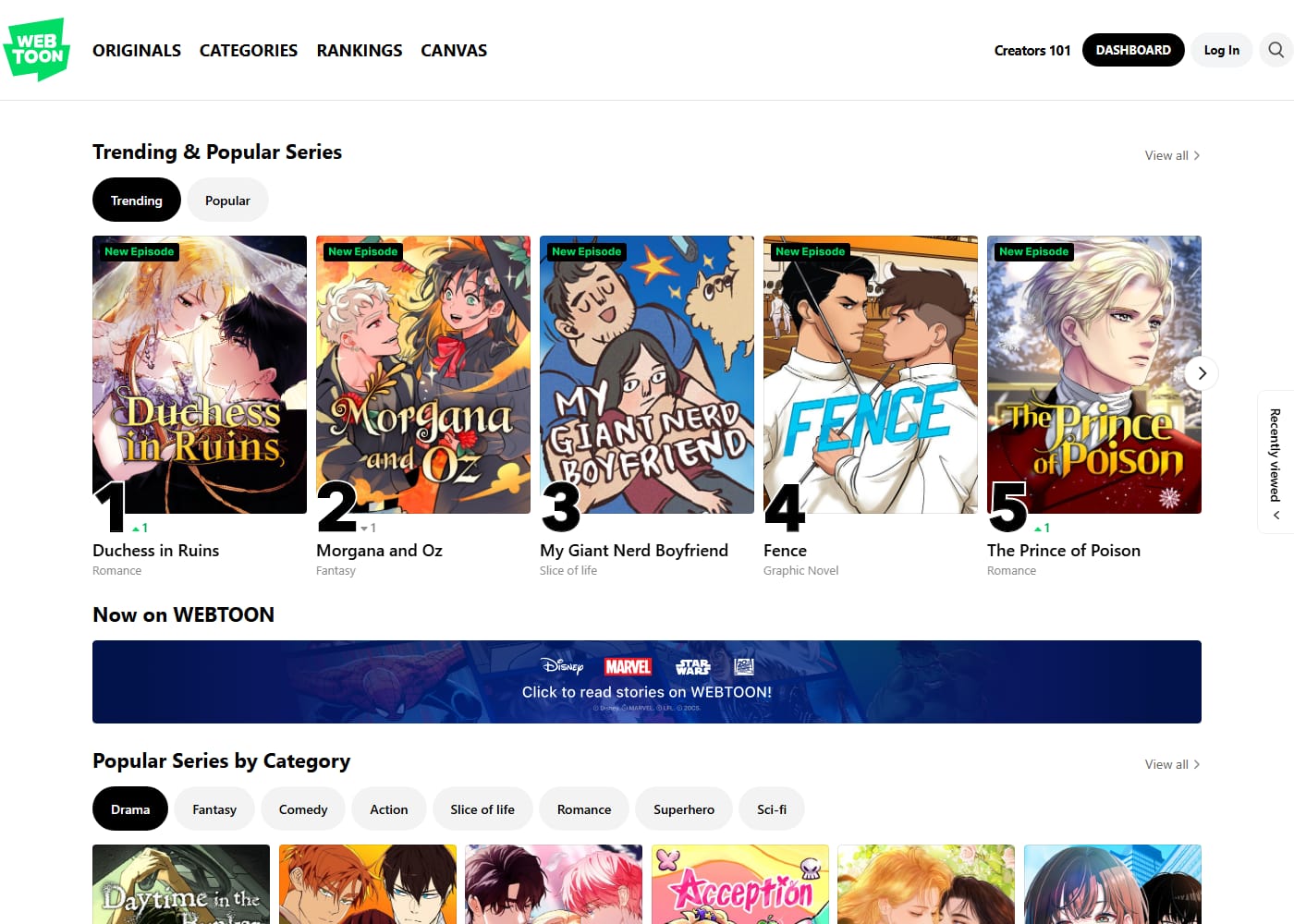
Where to Read Korean Webtoons: Naver vs Kakao, and the App Confusion
Is WEBTOON the same as Naver Webtoon? Where do Koreans actually read? Which apps are legal? The platform map nobody explains — Naver's Nasdaq-listed empire, Kakao's wait-until-free invention, and the right app for how you read.

Korean University Life: Study Hard, Play Harder Culture Explained
A practical guide to Korean university life: study pressure, campus festivals, MT trips, clubs, exams, drinking culture, and exchange-student reality.

Korean Work Culture: Overtime, Hierarchy, and Hof Fridays
A practical guide to Korean work culture, office hierarchy, overtime rules, hoesik dinners, and how Korean workplaces are changing.