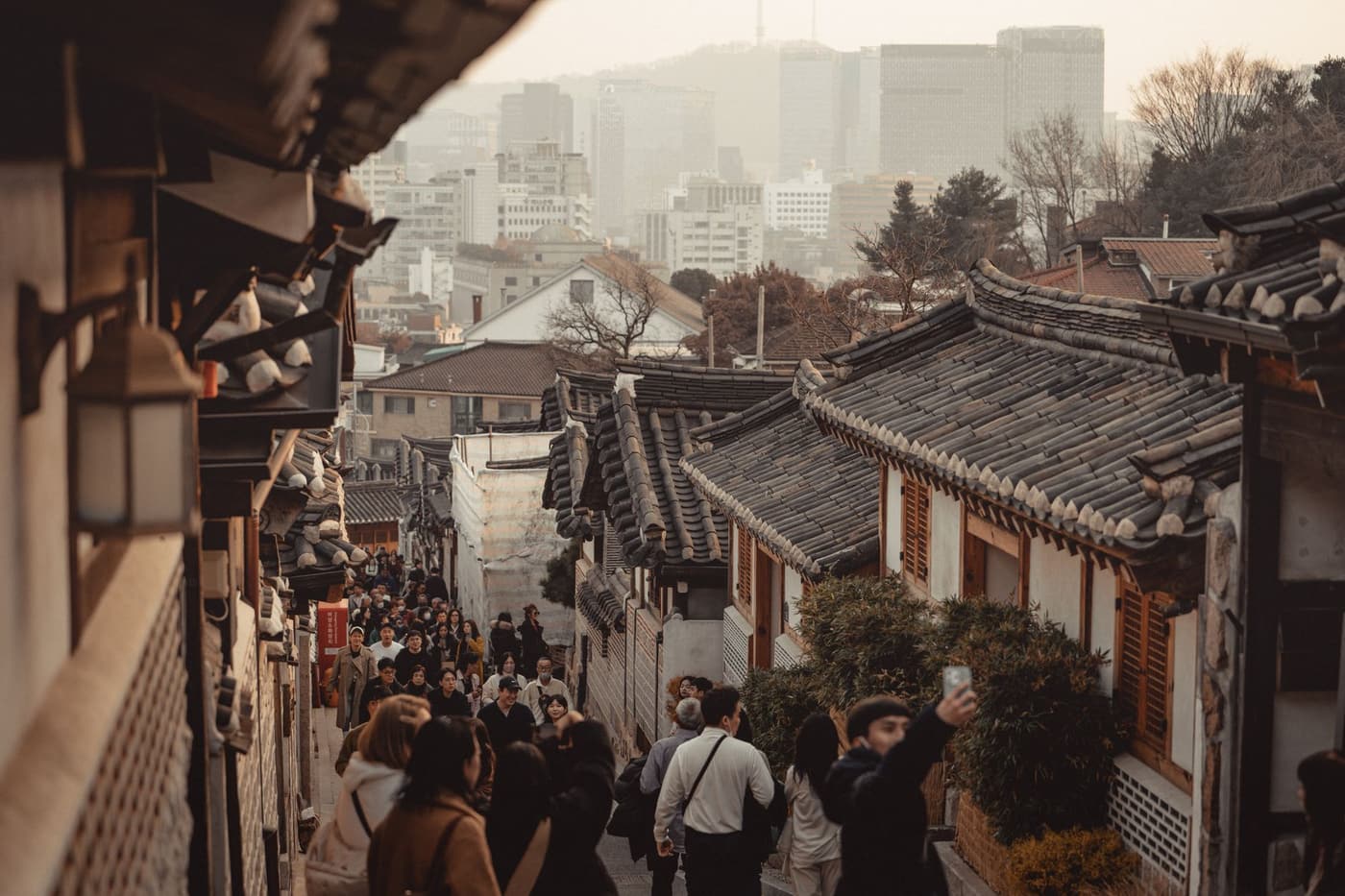
Bukchon Hanok Village: Seoul's Most Instagrammed Place
Bukchon Hanok Village is where a lot of Seoul visitors learn the hard truth about travel photos: the prettier the alley looks, the more carefully you need to behave.
For a fuller old-Seoul route, connect this Bukchon guide with EpicKor's Seoul hanok experience guide and Seoul palace night guide.
Yes, the tiled roofs are gorgeous. Yes, the hill views make Seoul look like it paused between Joseon history and glass-tower modern life. And yes, if you search for Seoul photo spots, Bukchon will show up again and again.
But Bukchon is not a theme park.
It is a real neighborhood in Jongno-gu, sitting between Gyeongbokgung Palace and Changdeokgung Palace, with hanok homes, small cultural spaces, cafes, workshops, residents, school routes, delivery scooters, and people who would like their front door to stop becoming someone else's content.
That is what makes Bukchon beautiful and complicated at the same time.
Lonely Planet Seoul — plan Bukchon with the rest of the cityAffiliate link. As an Amazon Associate, EpicKor earns from qualifying purchases at no extra cost to you.
Bukchon Is Beautiful Because It Is Still Lived In
The first mistake visitors make is treating Bukchon like one famous staircase or one viral hill.
Bukchon is bigger and softer than that. The name means "north village," referring to its position north of old central Seoul landmarks such as Cheonggyecheon and Jongno. Historically, this area sat close to royal palaces and administrative life, so it became associated with elite homes, scholars, officials, and the architecture of old Seoul.
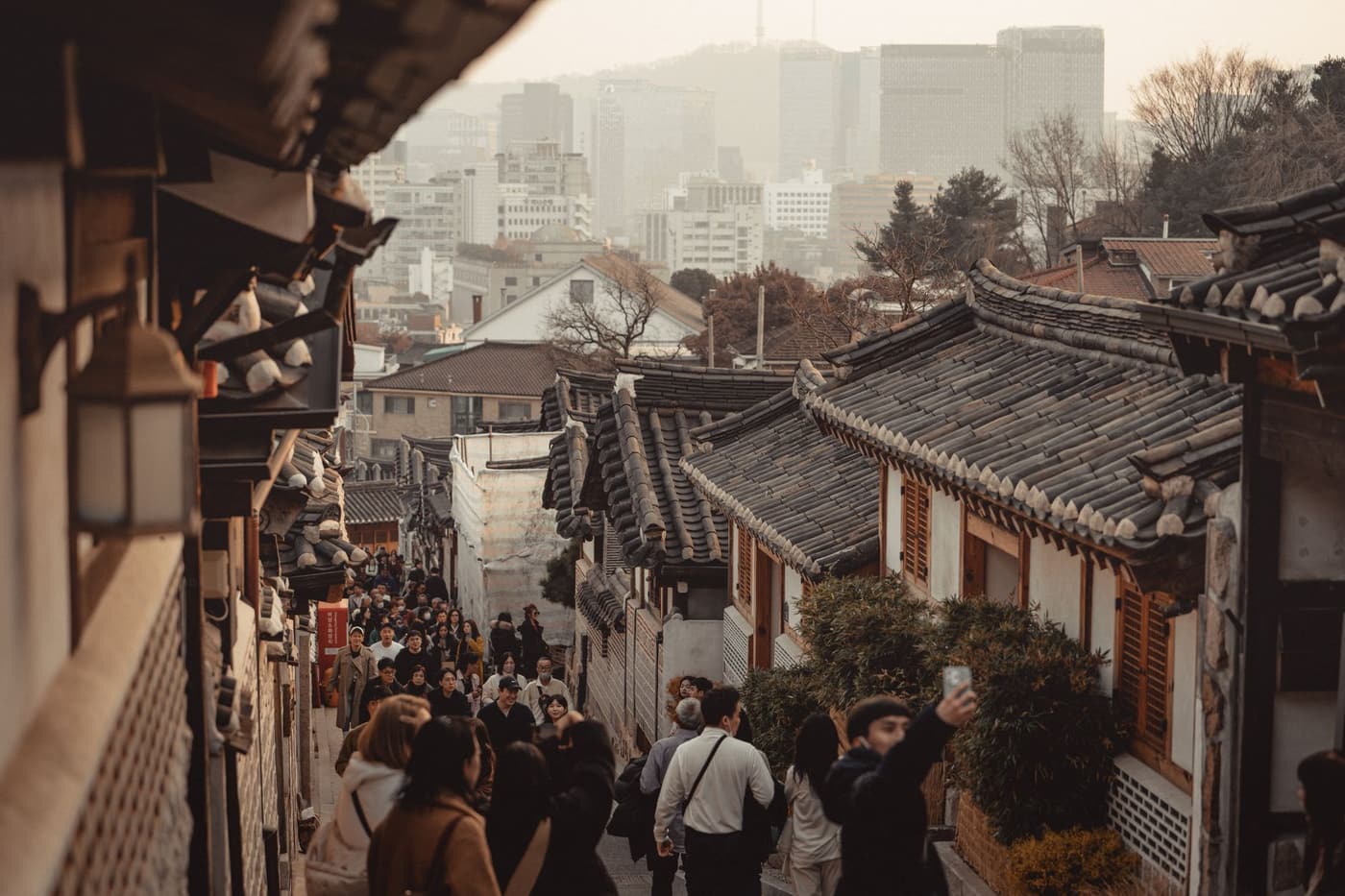
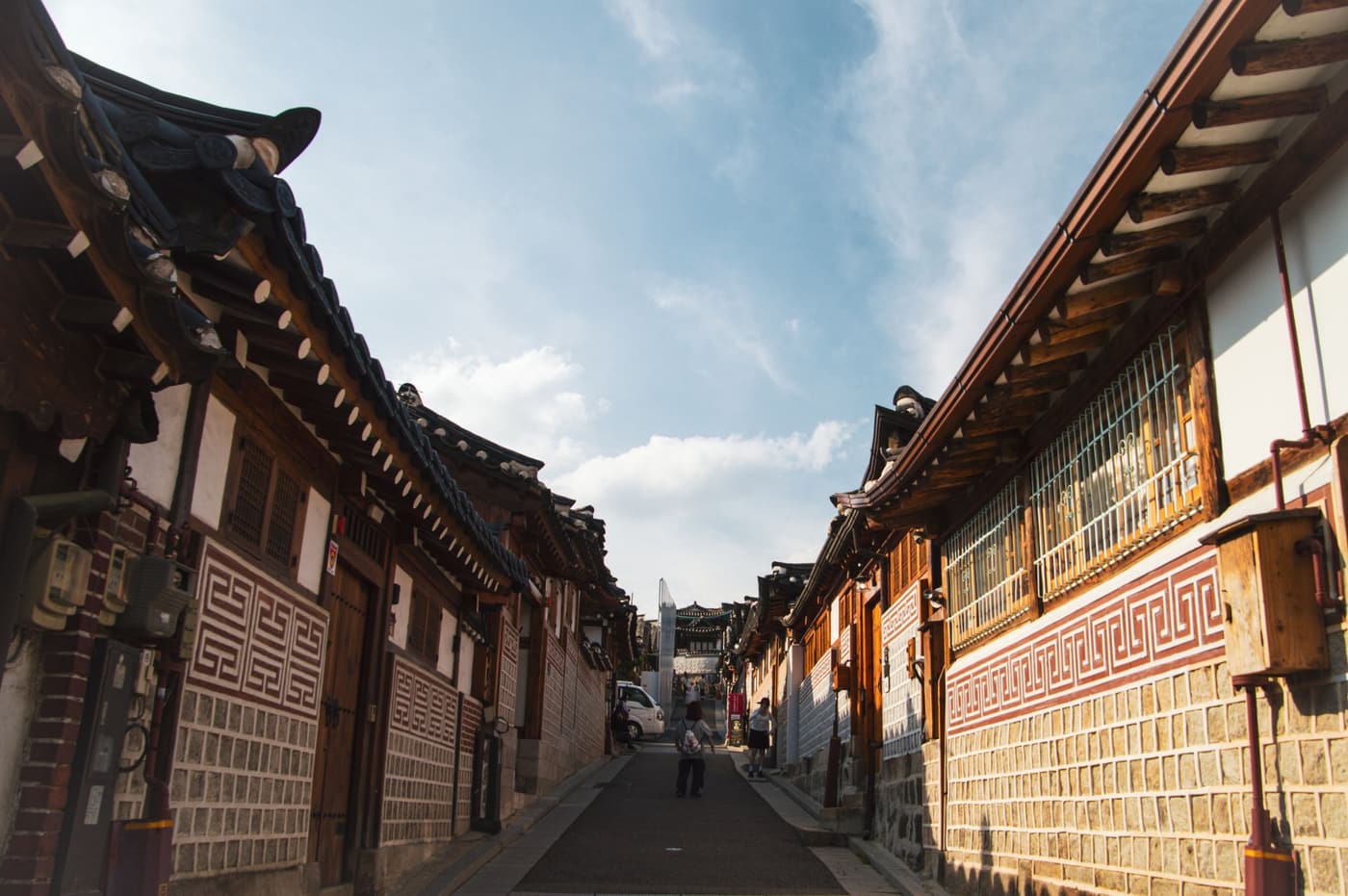
Today, people visit because many hanok remain in the area. A hanok is a traditional Korean house, usually recognized by its curved tiled roof, wooden structure, courtyard logic, and low relationship with the surrounding land. In Bukchon, those rooflines stack beautifully along the slopes. When you look down a narrow alley and see hanok tiles, Seoul skyscrapers, and mountain hints in the same frame, the city suddenly makes visual sense.
That is why people pull out their phones.
What makes Bukchon Hanok Village unique is not only the architecture. It is the overlap. You are seeing old houses inside a dense modern capital, near palaces, galleries, tea rooms, museums, schools, restaurants, and regular homes. The charm is not frozen history. It is the friction of history still being used.
This is also why the mood can feel strange if you arrive expecting a tourist attraction with a ticket booth. There is no single gate where Bukchon begins. There is no one "main exhibit." You move from Anguk Station into side streets, then into narrower lanes, then into places where the line between public street and private life feels very thin.
That thinness is the whole point.
If you only come for a photo, you may feel finished in twenty minutes. If you understand the neighborhood, you will slow down. You will notice doors, nameplates, roof curves, stone walls, small signs asking for quiet, and the way people lower their voices when the street narrows.
Bukchon rewards that version of travel.
It is not the easiest Seoul place to visit responsibly, but it is one of the best places to learn how Seoul holds old and new together without making either side simple.
Why Bukchon Became The Seoul Photo
Bukchon became one of Seoul's most shared visual symbols because it gives visitors something very rare: a traditional-looking Korea photo that is still inside central Seoul.
You do not need to travel to a far historic town. You do not need a full day. You can ride the subway to Anguk, walk uphill, pass cafes and galleries, and suddenly find alleys where tiled roofs fold into each other. For travelers trying to build a Seoul itinerary, that convenience matters.
The photo logic is obvious once you stand there.
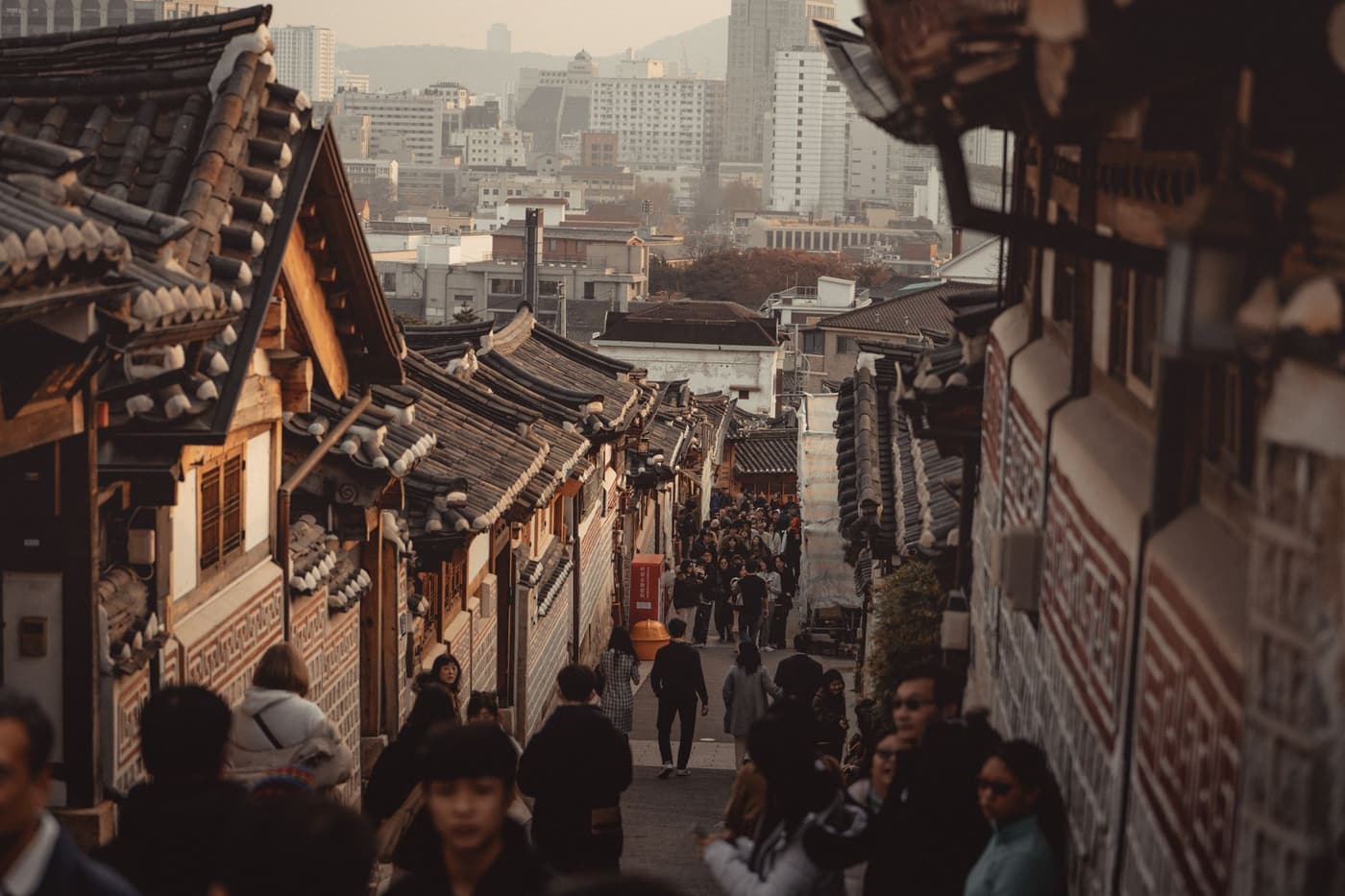
The streets are narrow enough to frame the body. The roofs have a repeating rhythm. The slopes create depth. Hanbok rentals nearby add bright color. Palace visits are close enough to combine into the same day. And because Bukchon sits near Insadong, Samcheong-dong, Gyeongbokgung, Changdeokgung, and the Seoul Museum of Craft Art, it fits naturally into a culture-heavy route.
That is the good version.
The messy version is that social media flattened Bukchon into a checklist. People started chasing the same uphill angle, the same doorways, the same "quiet traditional Korea" look. Some visitors arrived early, late, loud, or in large groups. Some blocked alleys. Some photographed private homes like displays.
That is how a beautiful neighborhood becomes exhausted.
Since 2025, the rules have become more serious. In the Red Zone around the Bukchon-ro 11-gil area, tourist visits are restricted to 10:00 AM to 5:00 PM. Tourism activity outside those hours can lead to a 100,000 won fine. The policy is aimed at reducing overtourism and protecting residents, and it applies to domestic and international tourists. Residents, their visitors, local business customers, and people simply passing through without tourism activity are treated differently, but if you are there to stroll, take photos, linger, film, or sightsee, assume the visitor rule applies.
That detail changes how you should plan.
Do not treat Bukchon as a sunrise shoot. Do not make it your late-night walking route. Do not assume "public street" means "anything goes." Plan your visit during the allowed daytime window, check local signs when you arrive, and keep your route compact.
There is a better way to think about the famous photo: take one, then earn the rest of your time by actually experiencing the area.
Korea-trip note: As an Amazon Associate, EpicKor may earn from qualifying purchases. If Bukchon is part of your first Seoul route, compare a practical Korea travel guide and a compact travel power bank before your trip, especially if maps and photos will drain your phone.
See travel power bank on AmazonHow To Visit Without Being That Tourist
The best Bukchon visit is short, quiet, and intentional.
Start around Anguk Station, preferably Exit 2 or 3 depending on your route. From there, move toward Jeongdok Library and the Bukchon cultural area instead of sprinting straight to the most crowded lane. If you are combining Bukchon with a palace, visit Gyeongbokgung or Changdeokgung first, then walk into Bukchon during the legal daytime window.
If Seoul transit still feels confusing, read EpicKor's Seoul subway etiquette guide before you go. Bukchon is easy to reach, but choosing the right station exit and planning your next stop will make the day much smoother.
The simplest route is not complicated.
Walk from Anguk into the cultural streets, visit a museum or gallery, pass through quieter hanok lanes, take a restrained photo stop, then exit toward Samcheong-dong, Insadong, or one of the nearby palaces. This keeps you moving rather than clustering in one residential alley.
Here is a better mental checklist than "get the shot."
| Visitor Move | Better Choice | Why It Matters |
|---|---|---|
| Arriving before 10:00 AM for empty streets | Visit during the 10:00 AM to 5:00 PM window | The Red Zone restrictions are designed to protect residents' quiet hours. |
| Taking photos in front of private doors | Use wider street views and avoid home entrances | A beautiful doorway may still be someone's actual front door. |
| Stopping a group in a narrow alley | Step aside quickly and keep walking | Residents, workers, and other pedestrians need the street too. |
| Treating Bukchon as a free photo studio | Spend time at museums, craft spaces, cafes, or tea rooms | Local businesses and cultural spaces carry more value than one viral angle. |
The easiest etiquette rule is this: behave as if your own apartment door were just off camera.
That means no shouting across the alley, no blocking stairways, no sitting on private steps, no filming residents, no drones, no changing clothes in public corners, no using doorways as props, and no treating signs as decoration. If a volunteer, officer, resident, or sign asks you to move, move.
You can still take beautiful photos. Just take them lightly.
Use a normal lens or phone camera instead of a long production setup. Take a few shots, then put the camera down. Include rooflines, street curves, and public views rather than zooming into windows or nameplates. If you rent hanbok, remember that the clothing does not turn the neighborhood into a stage.
Also, do not skip the non-photo parts.
Bukchon and nearby streets have tea houses, small galleries, craft workshops, cultural centers, cafes in renovated hanok, and routes toward Samcheong-dong and Insadong. Those are not filler. They are how you make the visit more balanced. A tea break, a small exhibition, or a craft shop gives your day texture and keeps Bukchon from becoming one crowded hill.
If you want a fuller half-day, pair Bukchon with one nearby area instead of five. Changdeokgung gives the day a palace-history feeling. Gyeongbokgung makes sense if you are already renting hanbok. Insadong adds souvenirs, tea, calligraphy, and traditional craft shopping. Samcheong-dong adds cafes and galleries. The Seoul Museum of Craft Art adds context without forcing more street crowding.
Try not to turn the day into a race. Bukchon is much better as a slow two-hour walk than as a ten-minute checkpoint squeezed between palace gates and shopping bags.
Quiet-walk kit: As an Amazon Associate, EpicKor may earn from qualifying purchases. For a palace-and-Bukchon day, compare a light packable travel daypack or a small Korean phrasebook so you can carry less, ask better questions, and stay focused on the neighborhood.
See Korean phrasebook on AmazonThe most important thing is not whether you find the exact photo everyone else took.
It is whether you leave the neighborhood feeling like you noticed a real place.
FAQ About Bukchon Hanok Village
Q: What is Bukchon Hanok Village?
Simply put, Bukchon Hanok Village is a historic residential neighborhood in Jongno-gu, Seoul, known for traditional Korean hanok houses, narrow alleys, palace proximity, cultural spaces, cafes, and popular photo views.
Q: Is Bukchon Hanok Village free to visit?
Yes, the streets themselves do not require an admission ticket. However, some museums, workshops, cafes, tours, or nearby palace sites may have their own costs. Free access does not mean unlimited behavior, because many streets are residential.
Q: What time can tourists visit Bukchon Hanok Village?
For the Red Zone around Bukchon-ro 11-gil, tourist visits are restricted to 10:00 AM to 5:00 PM under the current enforcement policy. Tourism activity outside those hours can trigger a 100,000 won fine, so check local signs and plan your walk during the daytime window.
Q: Where is the best photo spot in Bukchon?
The famous uphill hanok street around Bukchon-ro 11-gil is the image many visitors recognize, but the better answer is to find wider public views that do not block residents or private doors. Roofline photos, side-street curves, and palace-linked walks often feel more respectful than standing in front of homes.
Q: How long should I spend in Bukchon?
Most visitors can enjoy Bukchon in about one to two hours if they walk calmly, take a few photos, and add one tea house, gallery, museum, or craft stop. If you combine it with Changdeokgung, Gyeongbokgung, Insadong, or Samcheong-dong, make it a half-day plan.
The Better Way To Remember Bukchon
The most disappointing way to visit Bukchon Hanok Village is to arrive with a saved pose, wait for strangers to move, take the same photo, and leave.
That version technically works. You will have proof. You will have the roofline. You may even have the exact angle you saw online.
But you will miss the reason the place matters.
Bukchon is not beautiful because it is empty. It is beautiful because Seoul somehow still has these lanes, these roofs, these walls, and these tensions inside a city that keeps rebuilding itself. The neighborhood is photogenic, but the photo is only the surface. Under it are residents, preservation choices, tourism pressure, old class history, palace geography, and the everyday effort of sharing a street with the world.
So take the photo.
Then lower your voice. Move aside. Read the signs. Buy tea if you sit in a cafe. Visit a small cultural space. Walk toward a palace. Let the neighborhood be more than your background.
That is how Bukchon becomes more than Seoul's most Instagrammed place.
It becomes a real memory.
You Might Also Like
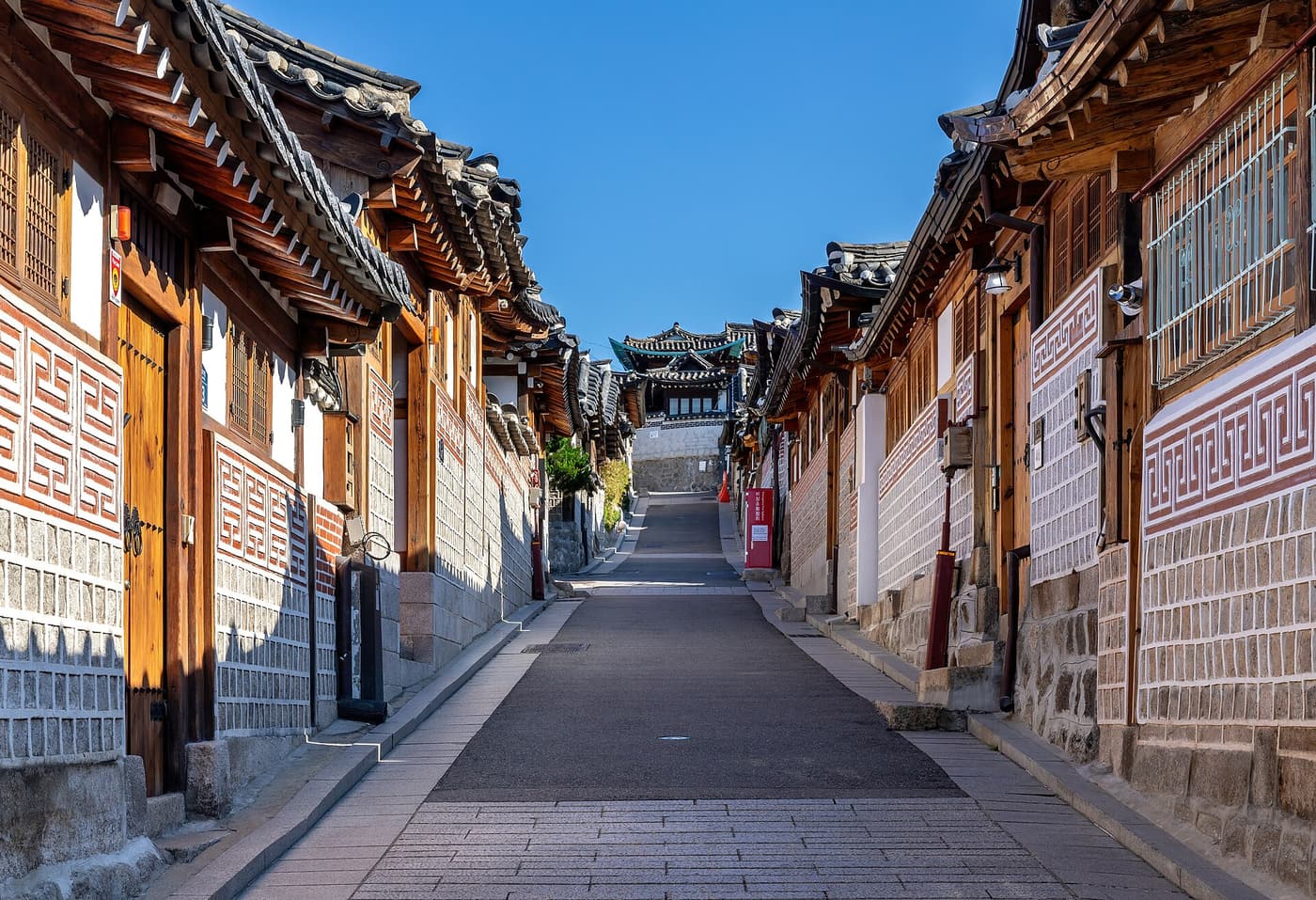
Bukchon Hanok Village, Seoul: The Village That Now Has Legal Visiting Hours
Bukchon is Korea's first Special Management Area for tourism. Since November 2024 the red-zone street has been closed to sightseeing after 5pm, with a ₩100,000 fine enforced from March 2025. It was also built by the same developer as Ikseon-dong.
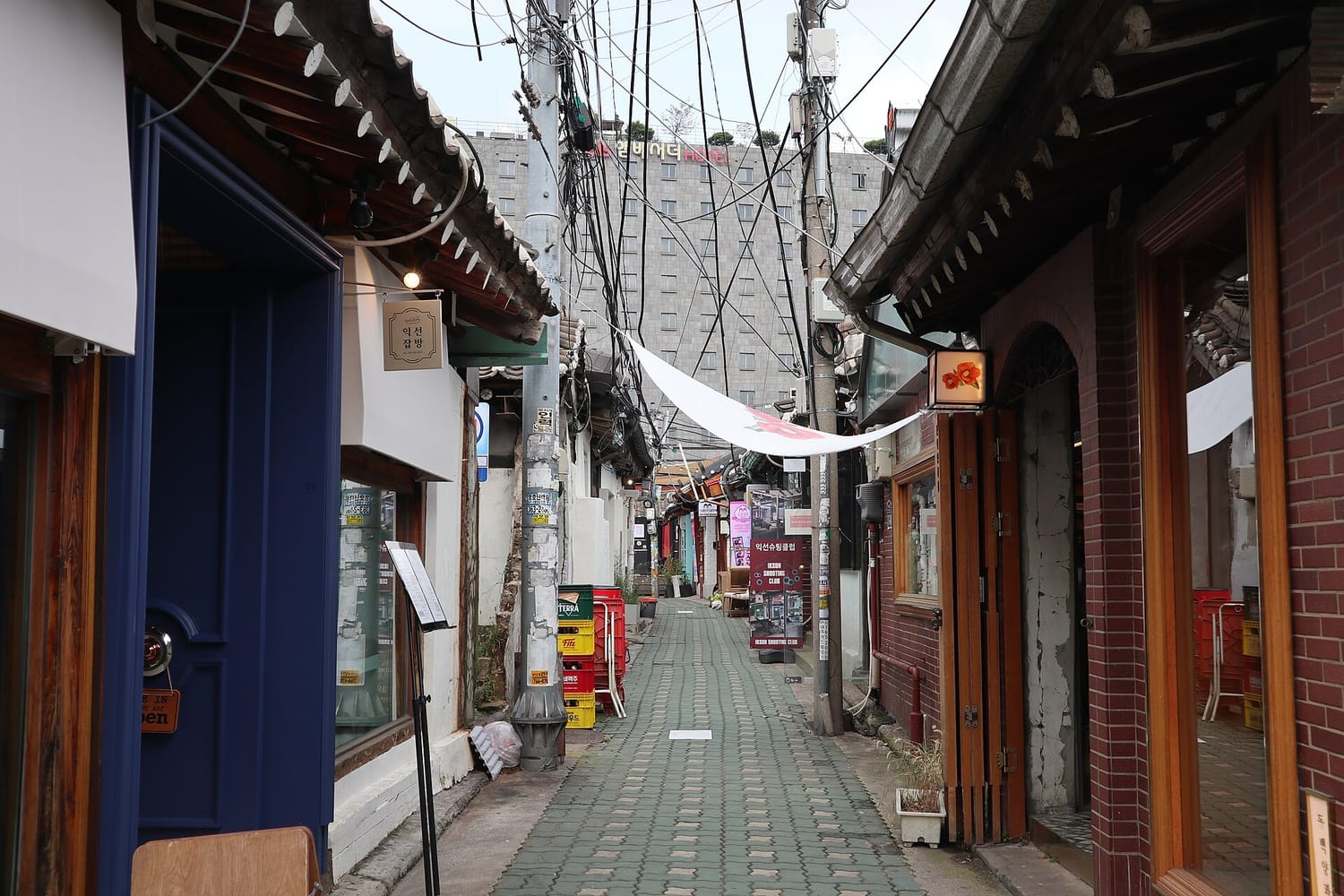
Ikseon-dong, Seoul: The Hanok Village a Developer Mass-Produced in the 1920s
Ikseon-dong is Seoul's oldest surviving hanok village, and it was not preserved from the Joseon era. It was built as a speculative housing development in the late 1920s, and it survived because redevelopment plans kept failing for nearly twenty years.

Korean McDonald's: Why the Burgers Are Named After Farm Counties, and What to Order Now
McDonald's Korea has bought 459.2 tonnes of named Korean produce since 2021 and prints the county on the burger — Changnyeong garlic, Jindo spring onion, Jinju pepper. 24 million sold, ₩61.7 billion of measured regional value. Here is what is on the menu now.